Chinese calligraphy is the art of writing Chinese characters with a brush. It is not just a tool for recording information, but also a long-standing visual art and a practice of spiritual cultivation.

An Invitation for the Eyes and Mind
The gentle rub of an inkstone, the subtle scent of pine-soot ink lingering in the air. A calligrapher holds a bamboo brush, dips it into ink, and with a graceful yet powerful movement of the arm, guides the brush across paper, leaving flowing black traces. This is not merely writing—it is a dynamic form of meditation, an enduring art we call Chinese calligraphy.

Info Card Overlay
UNESCO Recognition: Intangible Cultural Heritage of Humanity (2009)
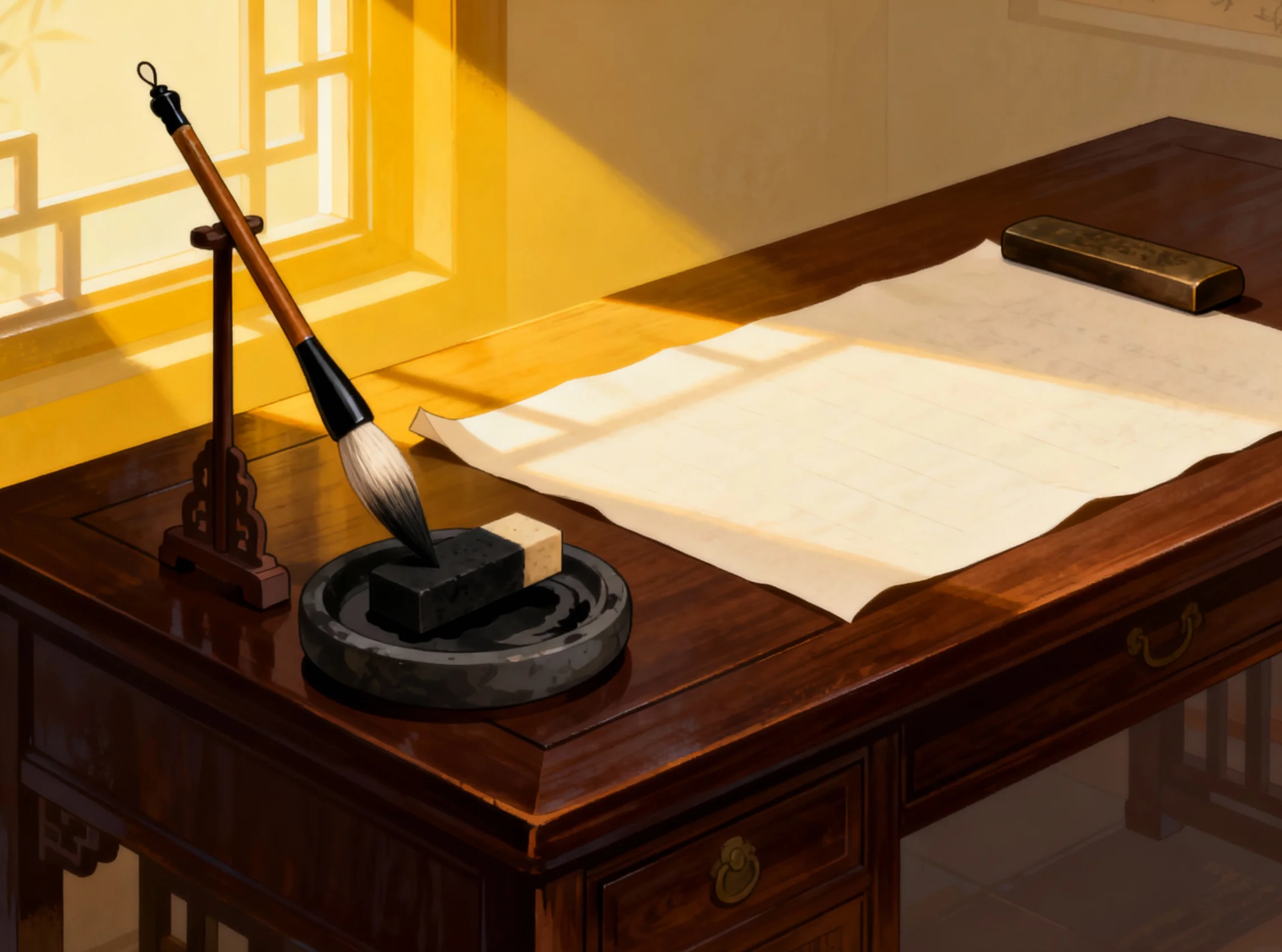
The Four Treasures of the Study: Brush, Ink, Paper, Inkstone
Core Idea: Artistic expression and spiritual cultivation
From Ancient Oracle Bones to Calligraphic Masterpieces
Mythical Origins
Legend says that when Cang Jie, a figure of ancient times, created Chinese characters, the gods wept, and grains rained from the sky. This myth reflects the sacredness of writing in Chinese culture.

Interactive Timeline: A 3,000-Year Journey
Oracle Bone Script (c. 1500 BCE): The earliest known Chinese writing, carved on animal bones for divination. Think of it as the mysterious ancient ancestor of modern characters.
Bronze Script (c. 1000 BCE): Inscribed on ritual bronze vessels—more structured and solemn.
Small Seal Script (c. 200 BCE): Standardized under China’s First Emperor. Elegant and uniform.
Clerical Script (Han Dynasty): A revolutionary breakthrough! Strokes became broader and flatter, allowing faster writing. This became the true foundation of modern characters.
Standard, Running, and Cursive Scripts (from c. 200 CE): The golden age of calligraphy!
- Standard Script (Kai Shu): Like print—clear and neat, perfect for learning (the “textbook” font).
- Running Script (Xing Shu): Like elegant cursive—smooth, quick, and rhythmic. Legible yet expressive.
- Cursive Script (Cao Shu): The abstract art of calligraphy! Highly simplified and fast. It emphasizes emotion and rhythm over readability.

More Than Just Beautiful Writing
Chinese calligraphy is a window into Chinese philosophy. Its goal is not to create perfect letters but to capture energy and balance.
Vitality and Rhythm (Qi Yun): A great calligraphy piece feels alive, like a moving image. You can sense the speed, pressure, and emotion in the strokes. Compare it to the energy in a Jackson Pollock drip painting—the movement frozen on paper.
Balance of Yin and Yang: Look closely at any character. You’ll see contrasts—thick and thin strokes, wet and dry ink, dense and open spacing. This harmony reflects a core principle of the universe.
A Form of Meditation: The focus required to control the brush calms the mind. In a way, it’s like yoga or mindfulness—the goal is to be fully present in the moment of creation.

Tools and Techniques: The Artist’s “Four Treasures”
This art relies on four special tools, known as the “Four Treasures of the Study.”
Brush: Typically made from animal hair (such as wolf or goat) bundled onto a bamboo shaft. Soft and flexible, it allows for endless variations in strokes.
Ink: Traditionally a solid inkstick, ground with water on an inkstone to produce liquid ink. Layering creates rich shades of gray.
Paper: Especially “Xuan Paper,” highly absorbent, allowing ink to bloom slightly at the edges—ideal for calligraphy.
Inkstone: A stone surface for grinding the inkstick and holding the liquid ink.

From Ancient Tradition to Modern Trend
You might be surprised how ubiquitous calligraphy is today!
Modern Design: Many well-known Chinese brands and logos use calligraphic fonts to add elegance and cultural depth.
Public Art and Fashion: Its influence appears in architecture, sculpture, and even clothing design.
A Hobby for All: Across China and the world, people of all ages learn calligraphy to relax and connect with culture. It’s a popular way to unwind.
Experience a Calligraphy-Themed Journey
Ready to see it for yourself? Here are some suggested itineraries:
Recommended Routes:
“Ink-Scented Jiangnan” Cultural Tour: Start in Hangzhou (visit the famous Xiling Seal Engraver’s Society), then travel to Huzhou (see traditional brush-making), and end in Shaoxing (the Orchid Pavilion, where the legendary calligrapher Wang Xizhi wrote the Orchid Pavilion Preface).
“Forest of Steles” Historical Exploration: Explore the Xi’an Forest of Stone Steles Museum, then visit Mount Tai to admire ancient calligraphy carved into cliffs.
Practical Tips:
Try a Workshop: Cultural centers in major cities like Beijing, Shanghai, and Guangzhou offer short-term calligraphy classes for tourists—a fun, hands-on experience!
Visit Museums: The Palace Museum in Beijing and the National Museum of China house stunning calligraphy treasures.
Observe Quietly: When watching a master at work, maintain a respectful silence—calligraphy requires deep concentration.
Copyright Disclaimer for Images
Some images displayed on this website are sourced from the internet and are used for informational and reference purposes only.
We respect the intellectual property rights of all creators. The use of these images is not intended to infringe upon any owner’s copyright.
If you are the copyright holder of any image used on this site and believe it is being used without appropriate permission, please contact us. Upon verification of your ownership claim, we will promptly take the necessary action, which may include removing the image or providing proper attribution as per your request.
Please reach out to us at: [email protected]