Introduction: A Whisper at the Wrist
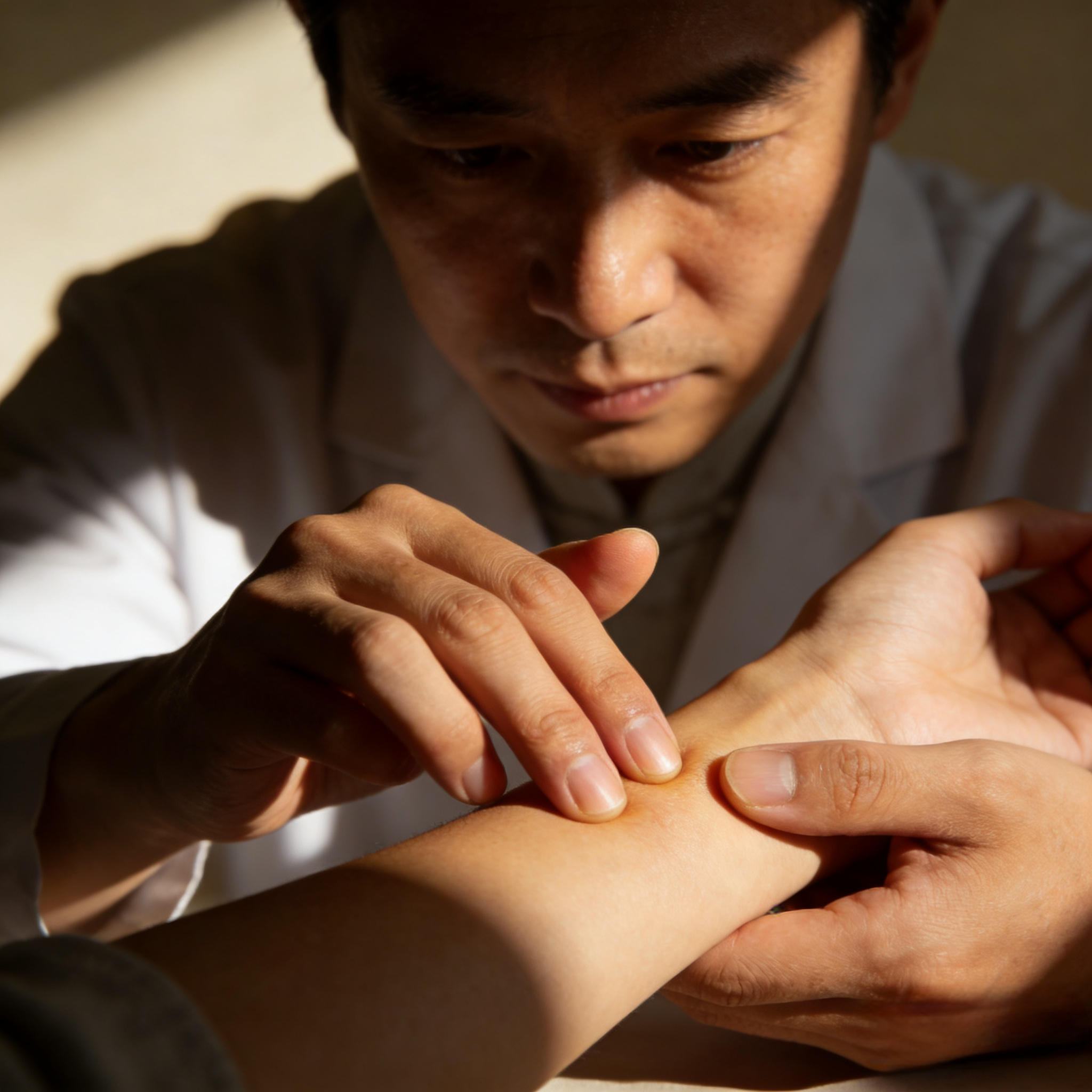
In traditional Chinese medicine, the body speaks. Its language is not words, but a subtle rhythm felt at the wrist. This is pulse diagnosis, a cornerstone practice where a practitioner reads over 20 nuanced pulse qualities. It’s akin to a skilled musician listening for the subtle harmonies and disharmonies in a complex symphony of life.

The Three Points of Insight
The practitioner feels not one, but three specific points on your radial artery. Each point corresponds to a different group of organs and bodily functions. By applying varying pressure—light, medium, and deep—they assess the flow of Qi (vital energy) and blood, mapping the state of your entire internal landscape through this single, elegant window.
Decoding the Language of the Pulse
What do they feel for? Not just speed. They interpret qualities like strength, depth, rhythm, and texture. A pulse might be described as “wiry” (like a tense guitar string), “slippery” (like pearls rolling in a dish), or “choppy” (like a knife scraping bamboo). Each metaphor translates into a specific insight about your health and balance.

A Philosophy in Practice
This art stems from a core belief in holism and interconnection. The body is seen as a miniature universe. The pulse reflects everything—from emotional states to digestive health. It’s a diagnostic tool that seeks the root cause, not just the symptom, much like a detective piecing together clues to understand a whole story.
A Living Tradition in Modern Life
Far from being obsolete, pulse diagnosis is a living bridge between ancient wisdom and modern wellness. In clinics worldwide, it informs personalized herbal prescriptions and lifestyle advice. For many, the experience offers a profound sense of being understood on a deep, systemic level that complements modern check-ups.

A Traveler’s Encounter: Feeling the Pulse
As a visitor, you can experience this in a traditional tea house with a resident practitioner or at a reputable TCM clinic in cities like Beijing or Shanghai. Approach it with curiosity. It’s a quiet, mindful ritual—a chance to pause and literally touch a 2,000-year-old tradition of attentive healing.

Conclusion: The Unbroken Rhythm
Pulse diagnosis is more than a check-up; it’s a meditative act of listening. It represents a profound belief in the body’s innate intelligence and our ability to understand its whispers. In a world of quick scans, it reminds us that some truths are felt, not just seen.
Have you ever experienced a traditional diagnostic method from another culture? What did it teach you about different perspectives on health? Share your story below!
Copyright Disclaimer for Images
Some images displayed on this website are sourced from the internet and are used for informational and reference purposes only.
We respect the intellectual property rights of all creators. The use of these images is not intended to infringe upon any owner’s copyright.
If you are the copyright holder of any image used on this site and believe it is being used without appropriate permission, please contact us. Upon verification of your ownership claim, we will promptly take the necessary action, which may include removing the image or providing proper attribution as per your request.
Please reach out to us at: [email protected]”