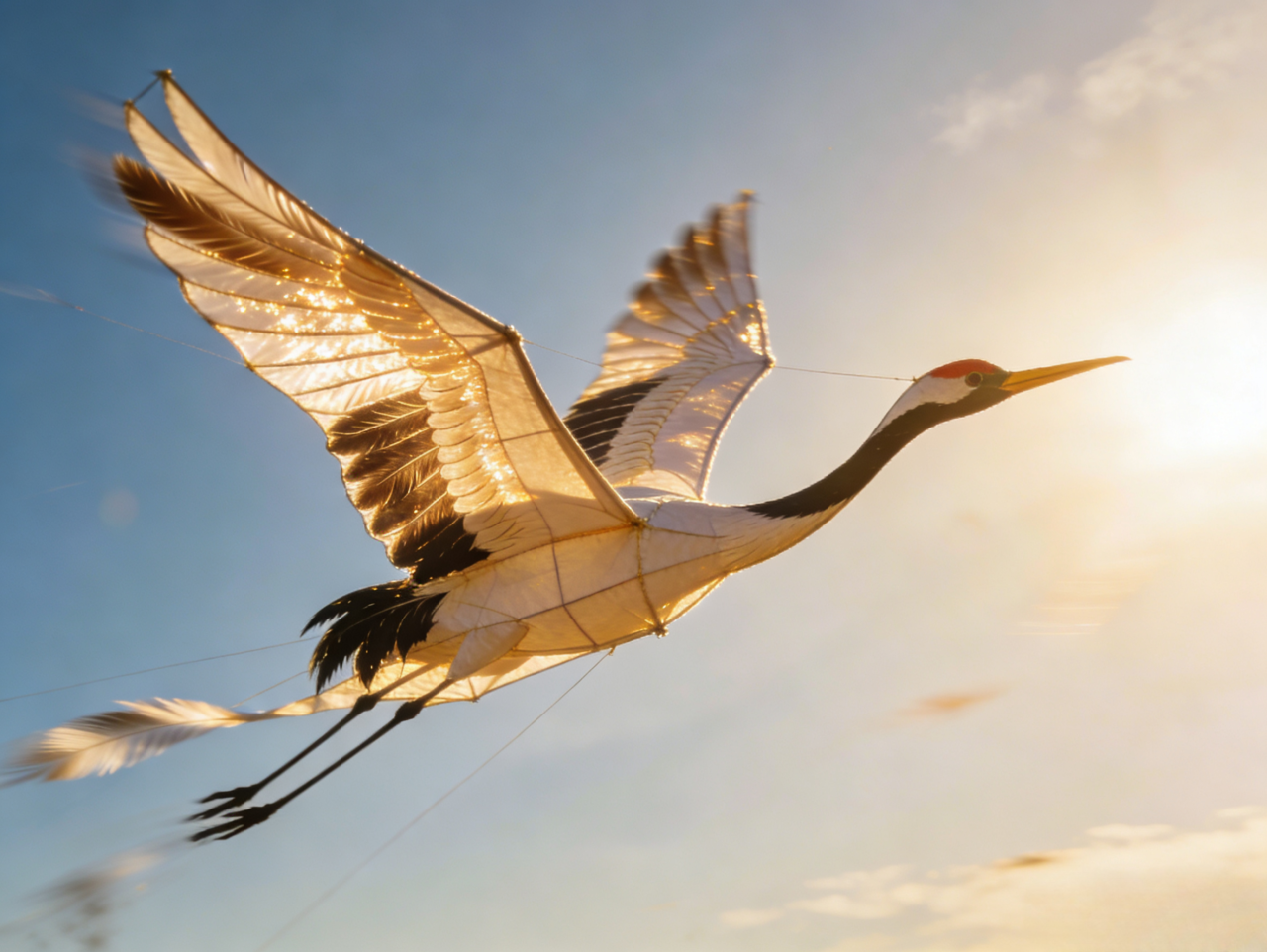
Imagine a kite that doesn’t just look like a bird—it actually uses real bird feathers to fly. This is the Feather Kite, a rare Chinese folk art. Unlike ordinary paper kites, these creations are covered with genuine feathers that flutter and shimmer in the wind, creating the illusion of a living creature soaring overhead.

Origins: Born from Nature’s Palette
Feather kites originated in the Jiangnan region of China, the scenic water towns south of the Yangtze River. Artisans observed how birds rode the wind and sought to capture that magic. By combining traditional kite-making techniques with the natural beauty of feathers, they created something unique—a flying sculpture that honors both craft and nature.

The Making: Four Steps to Flight
Creating a feather kite requires four meticulous steps: selecting materials, framing, covering, and attaching feathers. Artisans must choose feathers with perfect symmetry—a single eagle kite might need feathers from six different birds. Each feather is carefully positioned to catch the wind just right, following the natural flow of how they grow on a living bird.

The Feather’s Secret: Nature’s Engineering
Why use real feathers? Because nature is the best engineer. Feathers are incredibly light yet strong, water-resistant yet breathable. When arranged properly, they create tiny air pockets that help the kite float and stabilize. The natural curvature of each feather acts like a miniature wing, adding lift that no painted paper can match.

Traditional Forms: Eagles, Cranes, and Swallows
The most beloved feather kite designs mimic birds that hold cultural meaning. Eagles represent strength and vision. Cranes symbolize longevity and grace. Swallows announce the arrival of spring and good fortune. Each design requires studying the real bird’s plumage to recreate its distinctive coloring and feather patterns.
Living Masters: Carrying the Tradition
This delicate craft now rests in the hands of a few elderly masters. In Huzhou, Zhejiang province, Zhang Zhigang spent over 30 years creating more than a thousand feather kites. His eagle kite won national recognition in 1985 for its innovation. But since 2018, health issues have prevented him from making large kites—a loss for this rare art form.

A Vanishing Art: The Challenge Today
Feather kite craftsmanship faces a quiet crisis. Fewer than ten artisans in the Huzhou region still master the complete technique. Young people rarely learn the patient, detailed work required. In 2022, it was recognized as a municipal-level intangible cultural heritage, but preservation efforts struggle against the simple reality: this art takes decades to learn and a lifetime to perfect.
Why It Matters: More Than a Toy
Feather kites represent something precious—a conversation between human skill and nature’s design. Each kite carries the DNA of both the bird that grew the feathers and the artisan who arranged them. When such a kite flies, it’s not just a toy in the wind; it’s generations of observation, craftsmanship, and cultural memory taking wing.
A Traveler’s Window
For the curious traveler, seeing a feather kite is rare but possible. Visit folk art museums in Zhejiang or inquire at cultural heritage centers in Huzhou. If you’re lucky enough to encounter one, look closely at how each feather follows the natural grain—you’re seeing thousands of years of bird evolution and centuries of human artistry working together.
Conclusion: Flight of the Feathered Soul
The feather kite teaches us that the most beautiful creations often come from the simplest ingredients: bamboo, silk thread, and feathers that birds no longer need. It reminds us that art can borrow from nature without taking—just gathering what falls, arranging it with care, and sending it back to the sky where it belongs.
Have you ever seen a kite made from real feathers? What other traditional crafts in your culture use natural materials in unexpected ways? Share your discoveries below!
Copyright Disclaimer for Images
Some images displayed on this website are sourced from the internet and are used for informational and reference purposes only.
We respect the intellectual property rights of all creators. The use of these images is not intended to infringe upon any owner’s copyright.
If you are the copyright holder of any image used on this site and believe it is being used without appropriate permission, please contact us. Upon verification of your ownership claim, we will promptly take the necessary action, which may include removing the image or providing proper attribution as per your request.
Please reach out to us at: [email protected]”