
Introduction: The Tiger That Burns
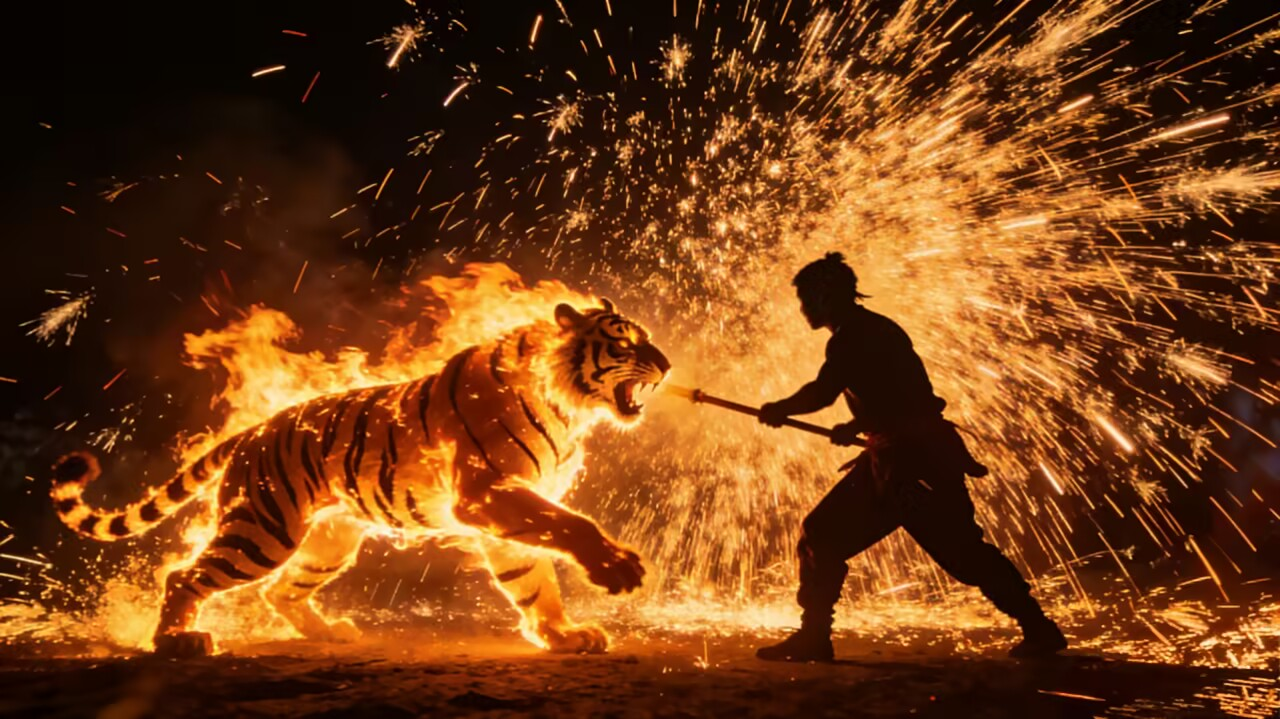
Imagine a creature made of pure fire, charging through the night. Sparks fly from its body like a thousand shooting stars. This is the Zoucheng Fire Tiger, a stunning folk art from Shandong province. More than a performance, it is a living legend where man and flame become one, reenacting an ancient battle between a hero and a man-eating tiger.
A Hero’s Tale: The Legend Behind the Fire
The story comes from the Five Dynasties period, over a thousand years ago. A heroic warrior named Li Cunxiao, known as the “Thirteenth Guardian,” was said to have slain a ferocious tiger that terrorized villages. Local people in Zoucheng transformed this legend into a ritual, blending lion dance movements with fireworks to bring the battle to life—a unique tradition born over 120 years ago.

Crafting the Beast: 3,600 Sparks of Danger
The “Fire Tiger” is not a costume—it is a masterpiece of risk and craftsmanship. Made from 20 wooden boards linked into a tiger shape, every inch is drilled with tiny holes. Into each hole, performers insert firework strips called “fire tendons.” A full performance requires over 3,600 of these strips. The tiger head, woven from flexible willow branches, weighs 15 kilograms alone. The complete outfit, with all fireworks inserted, weighs about 25 kilograms—a burning burden carried by the performer.

The Protector: Armor That Burns Too
Facing the fire tiger is the “tiger beater,” playing the role of Li Cunxiao. He wears wooden armor with four flags on his back and a huge bamboo hat nearly 70 centimeters tall. His legs are shielded with wooden guards, and he carries an 180-centimeter staff. Every part of his gear is also packed with firework strips. When ignited, both fighters become living flames—man and beast locked in a duel of light and danger.
The Performance: Ten Minutes of Fire
As night falls, drums thunder and gongs crash. The tiger beater appears first, reciting his legendary lines: “I am Li Cunxiao, the Thirteenth Guardian!” Then the fire tiger charges in—all spectators’ candles are extinguished at once, leaving only the blazing beast visible. For ten minutes, they battle. The tiger leaps, sparks showering like meteors. The beater spins his staff into a fiery dragon. Firefighters with water stand ready, spraying mist that turns into rainbow sparks when it hits the flames. When the last spark dies, the “tiger” falls—the legend complete until next time.
A Family Secret: Passed Through Five Generations
For 120 years, this art belonged to one family: the Zhou clan of Pingyangsi Village. The craft of making fire strips—mixing charcoal, saltpeter, and sulfur, wrapping them in special paper—was a closely guarded secret. The knowledge passed from father to son for five generations. Even today, only a handful of masters truly understand the complete technique.

Rebirth from Ashes: Saving a Lost Art
The Fire Tiger nearly disappeared. After decades of silence, it was revived in 1985 through the efforts of local government and elderly artists. In 2006, it was officially recognized as a Shandong Provincial Intangible Cultural Heritage. Today, a performance requires fifteen to sixteen people working together—preparations alone take half a month. Every spark carries not just light, but the memory of a tradition that refused to die.
Why It Matters: Courage Made Visible
What makes the Fire Tiger special is not just the fire—it’s what the fire represents. It is courage made visible, danger embraced for the sake of storytelling. Unlike fireworks displays where you watch from a distance, here the flames are worn by the performers themselves. They dance with death and create beauty from risk. It embodies the spirit of “the more you strike, the more you prosper”—a blessing written in sparks.
A Traveler’s Guide: Witnessing the Fire
To see the Fire Tiger, travel to Pingyangsi Village, Taiping Town, Zoucheng City, Shandong Province. Performances traditionally occur during Chinese New Year and on the second day of the second lunar month. Check local announcements, as shows are rare and require weeks of preparation. The nearby village of Shangjiushan also hosts occasional performances. While in Zoucheng, visit the birthplace of Mencius—the great Confucian philosopher—at the Meng Temple and Meng Mansion.
Conclusion: Sparks That Tell Stories
The Zoucheng Fire Tiger is more than a folk art—it is fire given meaning. For ten blazing minutes, history breathes through sparks, and legends walk the earth in flame. It reminds us that the oldest stories are sometimes told not with words, but with light, heat, and human courage.

Have you ever seen a performance where fire plays the starring role? What rituals in your culture use flame to tell stories or bring blessings? Share your thoughts below!
Copyright Disclaimer for Images
Some images displayed on this website are sourced from the internet and are used for informational and reference purposes only.
We respect the intellectual property rights of all creators. The use of these images is not intended to infringe upon any owner’s copyright.
If you are the copyright holder of any image used on this site and believe it is being used without appropriate permission, please contact us. Upon verification of your ownership claim, we will promptly take the necessary action, which may include removing the image or providing proper attribution as per your request.
Please reach out to us at: [email protected]”