
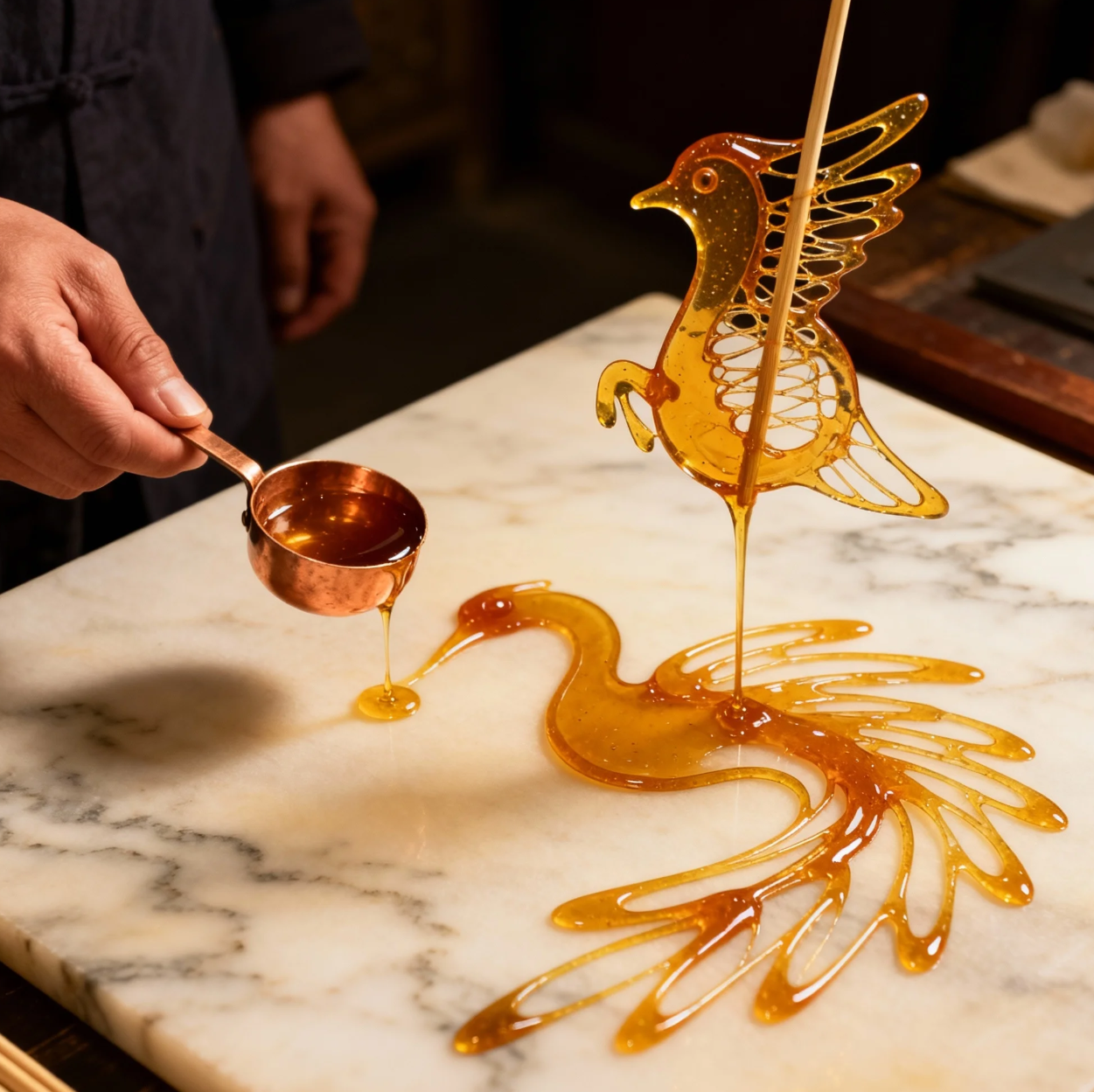
Watch golden syrup transform into delicate dragons, blooming flowers, and spirited animals in mere seconds—this is the fleeting magic of sugar painting. An ancient street performance turned edible art, it captures childhood wonder and centuries of folk tradition in one sweet, shimmering creation. Here, taste meets tale, and every piece is a delicious, disappearing masterpiece.
Sugar painting blossomed across China’s bustling marketplaces and temple fairs, particularly in Sichuan province where it remains a vibrant tradition. Today, it’s most authentically experienced in the lively ancient streets of Chengdu, Chongqing, or Xi’an, where artisans set up portable stalls amidst historic architecture. Major cultural festivals and tourist districts nationwide also offer chances to witness this swift, sweet craft in action.

Visual Miracle: Flowing Amber Art
The true spectacle lies in the artisan’s swift, sure-handed performance. Using a small copper ladle, they pour molten malt syrup onto a marble slab, tracing outlines with a continuous, graceful flow. In under a minute, the syrup cools into a translucent amber sculpture—a fragile, edible artwork held aloft on a bamboo stick.

Decoding the Making: The Sweet Magic of Creating a Painting in Four Steps
The making of sugar painting is a precise art of time, completed in a few minutes:
1. Boiling sugar: Maltose or granulated sugar is boiled in a copper pot to about 160°C, forming a golden-yellow thick syrup.
2. Conception: Based on the pattern chosen by the customer or the result of the spinning wheel, outline the contour in mind.
3. Pouring and painting: A small copper spoon is used to scoop up the syrup, and with the wrist suspended and moving evenly on the stone plate, the sugar liquid falls like golden threads to form the pattern.
4. Lifting the painting: When the syrup has slightly cooled but still retains its flexibility, a thin scraper is gently used to lift it and attach it to a bamboo stick.

Cultural Code: Auspicious Meanings on Bamboo Skewers
With roots in Ming Dynasty street culture, sugar painting served as both edible treat and popular entertainment. Common motifs—like the zodiac animal representing one’s birth year or the phoenix for good fortune—carry symbolic meaning, turning each piece into a personalized token of blessing, celebration, and shared joy.
Spin the wheel to win sweetness
The full experience begins with a spin of the “wheel of fortune”—a painted dial with various patterns. Where the pointer lands determines what the artist will craft for you. Watch the mesmerizing creation unfold, then receive your personalized edible art to admire and, finally, taste. It’s a playful, multisensory engagement with living folklore.
Look for sugar painting stalls in historic pedestrian streets, night markets, or during traditional festivals like the Spring Festival Lantern Fair. The experience itself takes just minutes, making it a perfect spontaneous delight while exploring. It pairs wonderfully with a food tour through Sichuan’s spicy delicacies or alongside other folk performances at a temple fair, offering a complete taste of local joy.
Sugar painting is a moment of pure, sweet alchemy—where skill becomes spectacle, and spectacle becomes a memory you can literally savor. It connects you to the playful heart of Chinese street culture in the most delightful way. Let your journey include this fleeting taste of magic, and carry home not just a souvenir, but a story that melts deliciously on the tongue.

Copyright Disclaimer for Images
Some images displayed on this website are sourced from the internet and are used for informational and reference purposes only.
We respect the intellectual property rights of all creators. The use of these images is not intended to infringe upon any owner’s copyright.
If you are the copyright holder of any image used on this site and believe it is being used without appropriate permission, please contact us. Upon verification of your ownership claim, we will promptly take the necessary action, which may include removing the image or providing proper attribution as per your request.
Please reach out to us at: [email protected]”