
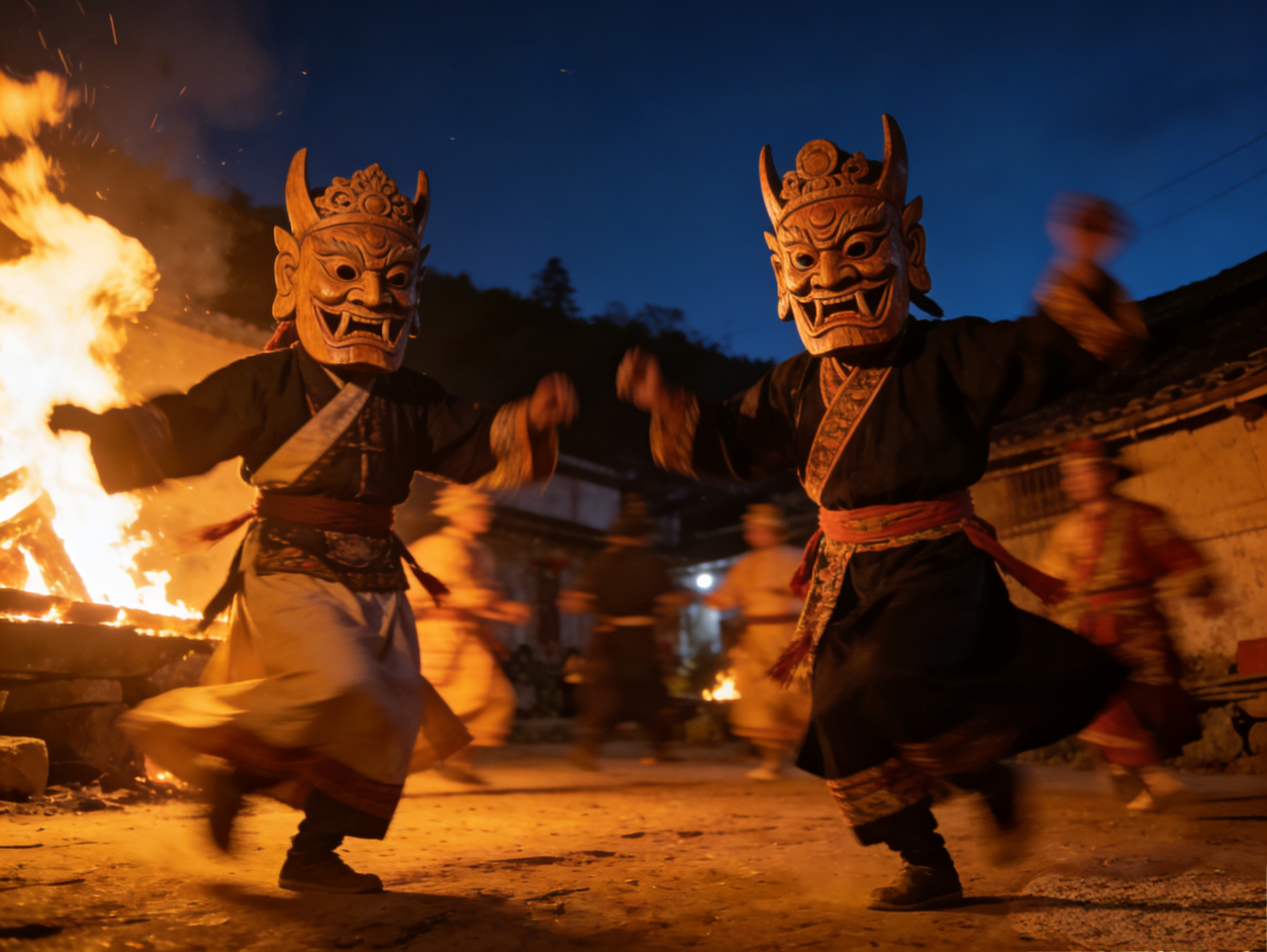
Imagine a village at night. Drums thunder. Firelight flickers across faces carved from wood—demons, judges, immortals. This is Nuo Opera, one of China’s oldest living theatrical traditions. For thousands of years, it has been performed not just for entertainment, but to drive away evil spirits and bring blessings to communities.

Origins: From Shaman to Actor
Nuo began as primitive religious ritual. Ancient shamans, called wu, performed ceremonies to chase ghosts and please the gods. They sang Nuo songs and danced Nuo dances. Over centuries, these rituals slowly transformed into theater. By the Song Dynasty (960-1279 AD) , Nuo Opera had taken shape across China, blending worship with performance.
The Three Great Transformations
Nuo became theater through three shifts. First, gods became humanized—fierce deities developed personalities and humor. Second, performances shifted from entertaining gods to entertaining people. Third, religious art became artistic religion, adding stories, jokes, and acrobatics to keep audiences engaged. This evolution made Nuo genuinely theatrical.

The Soul of Nuo: The Mask
In Nuo Opera, the mask is everything. Performers believe: “With the mask on, you are a god. With the mask off, you are human.” Masks are treated with deep respect—stored carefully, woken with ceremonies before use, and never treated as mere props. They bridge the mortal and spiritual worlds.

The Language of Faces
Nuo masks tell you everything about the character. Fierce masks with bulging eyes and fangs represent powerful warrior gods who fight evil. Gentle masks with kind faces belong to benevolent spirits who bring blessings. Comic masks look silly and make people laugh during serious rituals. Each face has its own personality and power.
Four Faces of Nuo
Nuo takes different forms across China. Civilian Nuo is performed in villages during New Year. Court Nuo was once staged in imperial palaces with hundreds of performers. Military Nuo tells stories of ancient battles, popular in Guizhou. Temple Nuo lives in Buddhist and Tibetan monasteries, where monks perform masked dances to purify sacred spaces.
Where Nuo Lives Today
Nuo survives most vibrantly in southwestern China. Guizhou province has the richest variety, with, Miao, Tujia, and Han communities all maintaining their own traditions. In Tongren city alone, there are about 130 active Nuo troupes and 168 officially recognized inheritors keeping the art alive.

A Living Art, Not a Relic
Nuo is not frozen in museums. In Chizhou, Anhui province, the Nuoxian Town scenic area stages nightly performances blending traditional Nuo with modern lighting and sound. Visitors can watch “The Legend of the Nuo King,” a spectacular show that makes ancient rituals accessible to contemporary audiences.
The Masks Speak Today
In 2025, a groundbreaking exhibition in Hunan invited visitors to interact with Nuo masks. Instead of glass-case displays, guests followed a maze, made choices, and encountered masks representing birth, sickness, death, joy, and sorrow. The experience ended with a blessing—just like a real Nuo ritual. Ancient tradition met modern participation.
A Traveler’s Guide to Nuo
To experience Nuo, visit Guizhou during Lunar New Year or special festivals. The Anshun region is famous for its Military Nuo , performed in villages with villagers wearing masks above their faces and black veils below. In Nanchang, Jiangxi, the Nuo Culture Park features hundreds of masks and occasional performances. Always ask permission before photographing rituals or masks.
Conclusion: The Eternal Exorcism
Nuo Opera carries something ancient—humanity’s desire to name our fears and dance them away. When the drums pound and masked figures leap through firelight, we watch our ancestors’ prayers still moving. It is theater with purpose: to heal, protect, and connect the living with powers beyond.
Have you ever experienced a ritual performance from your culture? What role does mask-wearing play in traditional ceremonies around the world? Share your stories below!
Copyright Disclaimer for Images
Some images displayed on this website are sourced from the internet and are used for informational and reference purposes only.
We respect the intellectual property rights of all creators. The use of these images is not intended to infringe upon any owner’s copyright.
If you are the copyright holder of any image used on this site and believe it is being used without appropriate permission, please contact us. Upon verification of your ownership claim, we will promptly take the necessary action, which may include removing the image or providing proper attribution as per your request.
Please reach out to us at: [email protected]”