
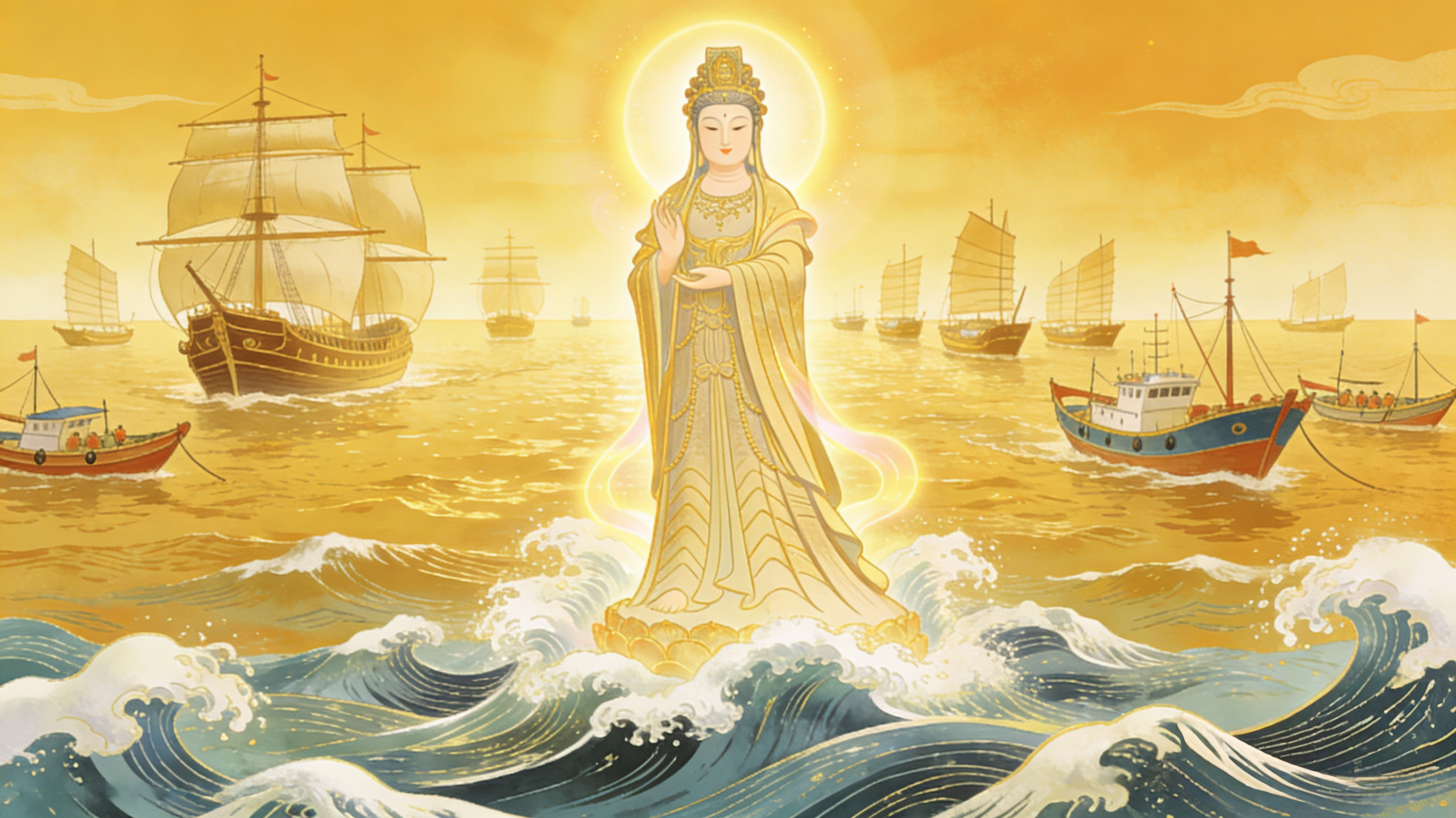
Introduction: The Guardian of the Waves
Imagine a goddess born not from myth, but from a real person who walked the earth. This is Mazu, the most influential sea goddess in China. For over a thousand years, she has watched over fishermen, sailors, and travelers across the world’s oceans. Her belief system, inscribed by UNESCO as Intangible Cultural Heritage, is a living tradition that blends history, spirituality, and the enduring human connection to the sea .

The Girl Who Became a Goddess
The story begins in the 10th century on Meizhou Island, Fujian province. A girl named Lin Moniang was born in 960 AD. From a young age, she showed extraordinary compassion—forecasting weather for fishermen, treating the sick with herbs, and guiding ships to safety. Legend says she once lit her own house as a beacon to rescue stranded sailors. In 987 AD, at just 28, she died attempting to save shipwreck survivors. Grateful villagers built a temple in her memory, and her legend began to grow .
From Local Maiden to Empress of Heaven
As maritime trade flourished, so did Mazu’s status. In 1123, she received her first imperial recognition for protecting a diplomat’s voyage. Over centuries, Chinese emperors bestowed upon her increasingly grand titles: “Heavenly Consort,” “Empress of Heaven,” and finally “Holy Mother in Heaven” — 36 imperial titles in total . This elevation from mortal girl to supreme goddess mirrors the growing importance of maritime trade in Chinese history.
The Core Spirit: Virtue in Action
At the heart of Mazu belief lie three simple virtues: “Establishing Virtue, Doing Good, and Showing Great Love” . Unlike abstract theological concepts, these are practical ethics embodied by Mazu’s life. She didn’t preach—she acted. She saved lives, healed the sick, and sacrificed herself for others. Followers honor her not by fearing her power, but by emulating her compassion .
The Belief System: More Than Religion
Mazu belief is not a formal religion with scriptures and dogma. It’s a living folk tradition expressed through three elements: ritual ceremonies, folk customs, and storytelling . Twice yearly, grand temple fairs mark her birthday and death day. Smaller ceremonies happen year-round in homes and temples—offerings of flowers, incense, candles, and firecrackers, evening processions with “Mazu lanterns,” and prayers for fertility, peace, and solutions to life’s problems .
The Two Guardians: Thousand-Mile Eyes and Favorable-Wind Ears
Step into any Mazu temple, and you’ll meet her two loyal guardians. Thousand-Mile Eyes can see across vast oceans; Favorable-Wind Ears can hear cries for help from any distance. Together, they represent Mazu’s omnipresent vigilance—always watching, always listening for those in danger at sea. Their fierce, colorful statues guard temple entrances, reminding visitors that someone is always watching over them .

A Network Across the Waves
From her tiny island birthplace, Mazu’s influence has spread across the globe. Today, over 10,000 Mazu temples exist worldwide, spanning 51 countries and regions . From Japan to South Africa, from the United States to France, wherever Chinese migrants settled, they brought Mazu with them. Even the name “Macau” comes from “Mazu Pavilion”—Portuguese sailors named the city after the temple they saw upon arrival .
Taiwan: The Island of Mazu
Nowhere is Mazu more deeply woven into daily life than Taiwan, home to over 500 Mazu temples . Each year, the Dajia Pilgrimage draws tens of thousands who walk 300 kilometers over nine days to honor her. Families worship together across generations. Every Mazu statue in Taiwan traces its roots to Meizhou Island—a spiritual umbilical cord connecting the island to the mainland across the Taiwan Strait .
UNESCO Recognition: A Treasure for All Humanity
In 2009, Mazu belief achieved global recognition. UNESCO inscribed it on the Representative List of the Intangible Cultural Heritage of Humanity, making it China’s first belief system to receive this honor . The UN recognized that Mazu “promotes family harmony, social concord, and the social identity of these communities” . Her message transcends borders.
Modern Relevance: A Bridge in a Divided World
In 2025, the 10th World Mazu Culture Forum drew participants from across the globe. A Brazilian city councilor noted how Mazu’s values “coincide with Brazilian people’s emphasis on family, love of life, and pursuit of harmony” . A German sinologist observed that “wherever Chinese people gather, Mazu culture is passed down” . Most remarkably, in February 2026, Mazu was officially “divided” to Hungary—the 51st country to receive her spirit .
A Traveler’s Guide: Where to Meet Mazu
The spiritual heart is Meizhou Island, Fujian—her birthplace and the site of the ancestral temple. Visit during her birthday (23rd day of 3rd lunar month) or death day (9th day of 9th lunar month) for spectacular ceremonies. In Taiwan, experience the Dajia Pilgrimage in Taichung each spring. In Macau, visit the historic A-Ma Temple that gave the city its name. In Tianjin, the Grand Festival features the famous “Empress Parade” with hundreds of performers .
Conclusion: The Eternal Light on the Water
Mazu began as one girl who chose to help others. A thousand years later, she connects over 300 million followers across 51 countries . Her story teaches a universal truth: compassion needs no translation. Whether you call her Mazu, Tianhou, or the Sea Goddess, she represents humanity’s oldest prayer—for safe passage, for protection, for someone watching over us when the waters grow rough.
Have you ever visited a Mazu temple or encountered a sea goddess tradition in your own culture? What role does faith in protection play in maritime communities around the world? Share your stories below!
Copyright Disclaimer for Images
Some images displayed on this website are sourced from the internet and are used for informational and reference purposes only.
We respect the intellectual property rights of all creators. The use of these images is not intended to infringe upon any owner’s copyright.
If you are the copyright holder of any image used on this site and believe it is being used without appropriate permission, please contact us. Upon verification of your ownership claim, we will promptly take the necessary action, which may include removing the image or providing proper attribution as per your request.
Please reach out to us at: [email protected]”