
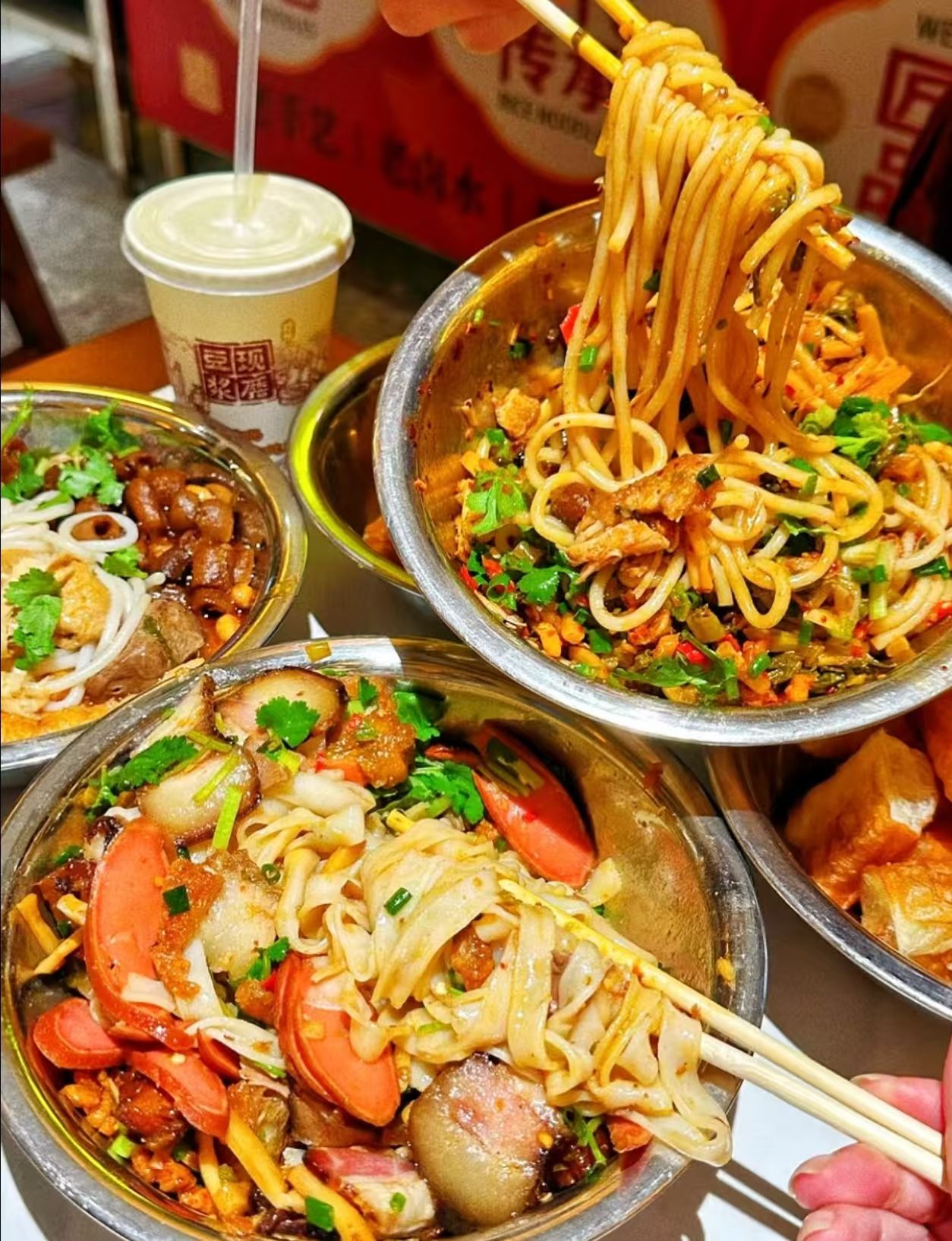
Originating from Guangxi’s karst mountains, handmade Guilin rice noodles are not just a local dish—they’re a craft passed down for over a thousand years. From grain selection to the final bowl, every step carries the maker’s care and connection to nature.

Where It Comes From: The Land of Rice Noodles
Guilin rice noodles are from Guilin City in Guangxi, a region famous for its limestone hills and winding rivers. The area’s mineral-rich water and mild climate produce the special rice that makes these noodles uniquely smooth and fragrant. Guilin is easy to reach by high-speed train from Guangzhou or Nanning, and is also connected by direct international flights.

Core Experience: Nature, Culture, and Craftsmanship
Water from the Li River and the subtropical climate of Guilin give the local rice a sweet aroma and soft texture—a key reason why the noodles taste so fresh and springy.

Culture and History: A Taste Over 2,000 Years Old
Guilin rice noodle-making dates back to the Qin dynasty, blending the food traditions of local ethnic groups like the Zhuang and Yao. In 2016, the craft was recognized as part of Guangxi’s Intangible Cultural Heritage.
The Making Process: From Grain to Noodle
The traditional process involves more than ten careful steps:
•
Selecting and soaking high-quality rice in Li River water.
•
Grinding the rice into a fine paste, then filtering it.
•
Spreading the paste onto bamboo trays and steaming it into thin sheets.
•
Rolling and cutting the sheets by hand into even strips.
•
Sun-drying the noodles to the right texture.
Skilled makers adjust each stage for the perfect chewiness—a craft that can’t be rushed.

Local Experiences: From Making to Tasting
Noodle-making workshop: Try the whole process in a time-honored workshop.
•
Taste the classics: Try a bowl of Guilin rice noodles topped with crispy pork, pickled veggies, and peanuts, just like the locals do.
•
Breakfast with a view: Enjoy fresh noodles in a small shop by the Li River at sunrise.
Practical Information: Visiting and Tasting
Best time to visit: Spring (March–May) offers mild weather and is perfect for pairing a noodle tour with a Li River cruise.
Suggested plan: Spend half a day in a workshop learning to make noodles, then explore nearby sights like Elephant Trunk Hill.
Local tip: Family-run shops in the old town often preserve the most authentic recipes and methods.
Conclusion: A Bowl of Noodles, A Taste of Guilin
A bowl of handmade Guilin rice noodles carries the flavor of the mountains, rivers, and time itself. We invite you to touch, make, and taste this age-old craft—and discover the rhythm of life in Guilin, one bowl at a time.
Copyright Disclaimer for Images
Some images displayed on this website are sourced from the internet and are used for informational and reference purposes only.
We respect the intellectual property rights of all creators. The use of these images is not intended to infringe upon any owner’s copyright.
If you are the copyright holder of any image used on this site and believe it is being used without appropriate permission, please contact us. Upon verification of your ownership claim, we will promptly take the necessary action, which may include removing the image or providing proper attribution as per your request.
Please reach out to us at: [email protected]”