
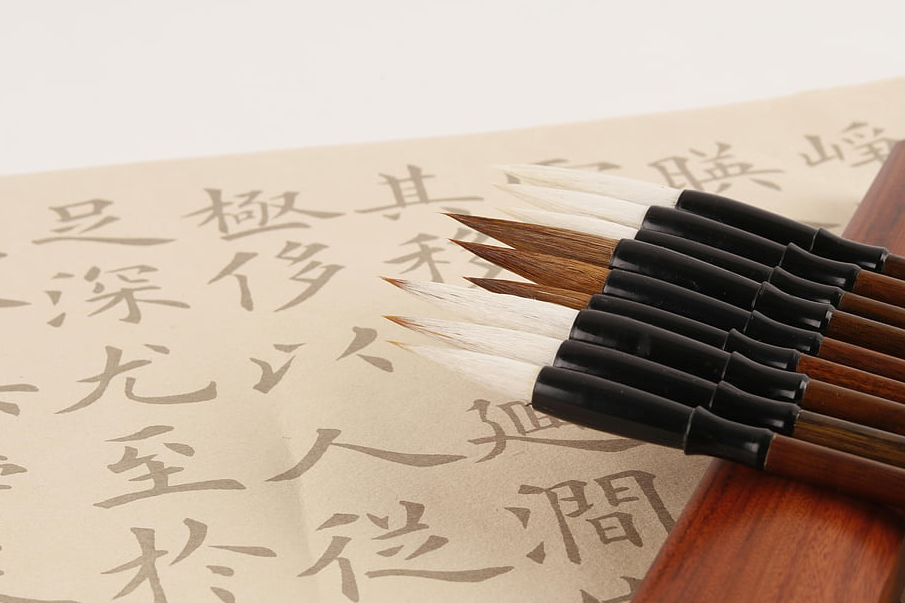
The “Four Treasures of the Study”: Simple Tools, Profound Art
Unlike complex Western art, Chinese calligraphy relies on four simple “Four Treasures of the Study” (Wenfang Sibao): brush, ink, paper, and inkstone.
More than just writing supplies, they form calligraphy’s foundation, each with unique roles and cultural meanings—understanding them is key to appreciating calligraphy.
The brush (bi) is calligraphy’s soul—soft animal hair on a bamboo handle lets calligraphers control stroke thickness and speed, unlike rigid Western pens.
Visiting a Hangzhou calligraphy studio, one might try holding a brush—even a simple “one” (yi) takes practice to look graceful, with light touches for elegance and firm presses for boldness.
This flexibility makes calligraphy expressive, as a master’s greeting strokes carry warmth beyond just ink.
Ink (mo) symbolizes simplicity and depth, made by grinding an ink stick on an inkstone—a slow, calming process.
In Shaoxing, a calligraphy-famous city, local artists may teach visitors to grind ink, explaining it calms the mind—no rushing, just like understanding a new culture.
Fade-resistant, this ink preserves ancient works, bridging past and present for all travelers.
Paper (zhi) and inkstone (yantai) complete the set, with rice paper (xuanzhi) being the most famous—thin, absorbent, and durable.
Xi’an’s calligraphy souvenirs are often on rice paper, which soaks ink evenly for soft, natural characters.
Good stone inkstones grind high-quality ink, and many travelers take small ones home as a reminder of calligraphy’s calm.

A Journey Through Time: The Evolution of Calligraphy Styles
With a 3,000-year history, Chinese calligraphy evolved with civilization, its styles reflecting each dynasty’s trends. Key styles tell China’s story.
Oracle bone script (jiaguwen), Shang Dynasty’s earliest form, was carved on bones/shells for divinations, simple and pictographic.
Beijing’s National Museum displays these old, rough bones, each mark telling stories of harvests and wars.
It laid the foundation for all later styles, its spirit still present in modern calligraphy.
Oracle bone script evolved into seal script (zhuanshu), popular in the Zhou Dynasty and standardized in Qin. Elegant and rounded, it’s still used in seals for its tradition and solemnity.
Han Dynasty’s clerical script (lishu), simpler and faster than seal script, bridged ancient and modern calligraphy with straight, angular strokes.
Today’s most used style, regular script (kaishu), developed in Wei-Jin and peaked in Tang—neat, standardized, and easy to read.
It’s everywhere: Shanghai’s street signs, textbooks, restaurant menus—connecting modern Chinese to their writing tradition.
Its precision reflects Confucian harmony, seen in teachers’ blackboard writing as a lesson in balance.
Cursive script (caoshu), the most expressive style, uses flowing, connected strokes. Tang masters like Zhang Xu created passionate, admired works.

Beyond Writing: Calligraphy as Culture and Philosophy
Chinese calligraphy is more than art—it reflects culture, philosophy, and character, known as the “art of the soul” for its role in cultivating the mind.
Rooted in Confucianism and Taoism: Confucian harmony is in regular script’s balance, while Taoism’s natural flow is in cursive, aligning writers with nature.
Calligraphy cultivates character—traditional learning focused on patience, focus, and humility, beyond just skill.
In Chengdu, children learn calligraphy after school, with teachers teaching “writing well is being good—no rushing, be honest.”
It calms the mind: ancient scholars’ strokes revealed their character; today, it’s a way to escape busyness, like travelers seeking peace in temples.
Calligraphy remains important today, practiced as a hobby despite computers and phones.
Chengdu and Hangzhou offer tourist calligraphy classes, where visitors learn to write their Chinese names as unique souvenirs.
It’s in modern design—café cups, traditional clothes, brand logos—connecting old and new, keeping Chinese culture alive.
In conclusion, Chinese calligraphy is far more than beautiful writing. This 3,000-year-old art combines simple tools with profound philosophy, reflecting history and shaping character, bridging cultures and time—every stroke tells a story of soul and culture.
