
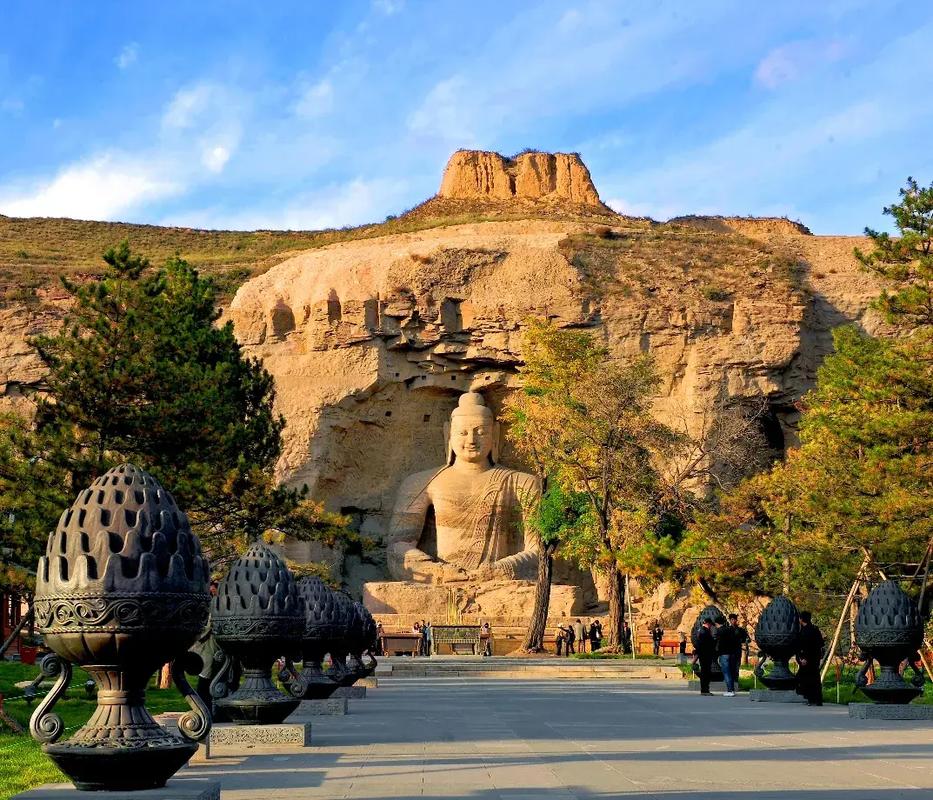
Located in northern Shanxi, Datong once served as the capital of the Northern Wei Dynasty and a major hub for Buddhist culture. It boasts numerous well-preserved temples and Buddhist relics from the Liao and Jin dynasties. It’s an ideal destination for culture lovers, ancient architecture enthusiasts, photographers and overseas history buffs who want to dive deep into Chinese Buddhist art. You can easily visit iconic grottoes and ancient pagodas in just three days.
Explore spectacular grottoes and ancient architecture
On your first day in Datong, head straight for Yungang Grottoes in the west of the city. As one of China’s three major grotto complexes, it’s famous for the grand outdoor giant Buddha. Exploring all the caves takes about two to three hours. In the evening, stroll along the ancient city wall downtown to relax.
On the second day, visit age-old temples built during the Liao and Jin dynasties. Start with Huayan Temple in the morning to admire its exquisite Bodhisattva statues. In the afternoon, explore Shanhua Temple and its fine ancient Buddha sculptures. Don’t miss authentic Datong daoxiao noodles for dinner.
For the third day, rent a car or join a tour group. First head to Hunyuan to see the breathtaking Hanging Temple built on a cliff. Then travel to Ying County to visit the Yingxian Wooden Pagoda, a thousand-year-old masterpiece constructed entirely with mortise and tenon joints, standing firm through the ages.

Discover the charm of Buddhist art
Commissioned by the imperial court of the Northern Wei Dynasty, Yungang Grottoes took nearly 60 years to complete. The statues show clear stylistic changes over time: the early works feature strong Western Regions influences, while mid-period sculptures took on gentle Chinese characteristics. Late-stage figures are elegant and refined, with every statue and cave design well worth a close look. Datong also preserves remarkable wooden buildings from the Liao and Jin dynasties. The main hall of Huayan Temple is grand in scale, boasting exquisite glazed decorations and sophisticated bracket sets. Shanhua Temple features a neat and well-organized layout. Keep an eye on details like roofs and beams during your visit, and you’ll truly appreciate the superb craftsmanship of ancient architects.

Handy tips before you go
Transportation: Getting to & Around Datong.
Datong has no international airport. You can take a high-speed train from Beijing, with the fastest ride taking just 3.5 hours. It is also well connected by high-speed rail to Hohhot and Taiyuan. For trips to the Hanging Temple and Yingxian Wooden Pagoda, joining a local one-day tour or renting a car is your best bet. The one-way drive takes around 1.5 hours and 2.5 hours respectively.
Best Time to Visit: April to October.
Located on the Loess Plateau, Datong sees cold, windy winters, so travel between November and March is not recommended. From April onward, flowers bloom and the weather turns pleasant. June to August is the peak tourist season — remember to apply sunscreen. September and October bring crisp, refreshing autumn days, another wonderful time for sightseeing.

This 3-day itinerary is laid-back and unrushed, taking you straight to the essence of Buddhist culture at every stop. You don’t need extensive historical knowledge to follow this route and trace the evolution of Chinese Buddhist art. It’s perfect for first-time cultural travelers to China.